

Digital solutions from the Global South
Big Tech's "quiet empire" is deepening global inequality. But, innovations from Africa are pioneering an ethical, community-centered digital future.

👋 “We are living inside the imagination of Western colonial powers from the 1700s,” says award-winning artist and activist Esther Mwema. In her work unravelling the “cosmologies of internet infrastructure,” Mwema exposes a startling reality: the high-speed fibre optic cables circling Africa today often trace the exact same routes as the telegraph cables used by 18th-century empires.
This is the “Quiet Empire”—a new era of digital colonialism where Big Tech giants establish a dependency that feels “neutral” but functions through extraction. As Mwema notes, “Infrastructure has always been a tool for resource extraction... today, it’s not just minerals, but also data to build artificial intelligence.”
In this edition, we dive into this critical divide—from the physical seabed to the code of our AI—to spotlight how the Global South is reclaiming its digital sovereignty.
In this newsletter:
📡 Esther Mwema exposes how digital infrastructure often reinforces the exploitative logics of colonial empires
💻 While AI is exploiting data labor across the Global South, we explore the growing swell of resistance and AI that centers humanity over profit
🗣️ How the lack of linguistic diversity in AI systems is deepening global inequality
🗺 Open-source tools and community engagement are creating a living database of essential infrastructure in Nairobi’s largest slum
☀️ These solar-powered computer labs are transforming learning in Kenyas’s most remote schools
Esther Mwema unmasks Big Tech’s quiet empire in Africa
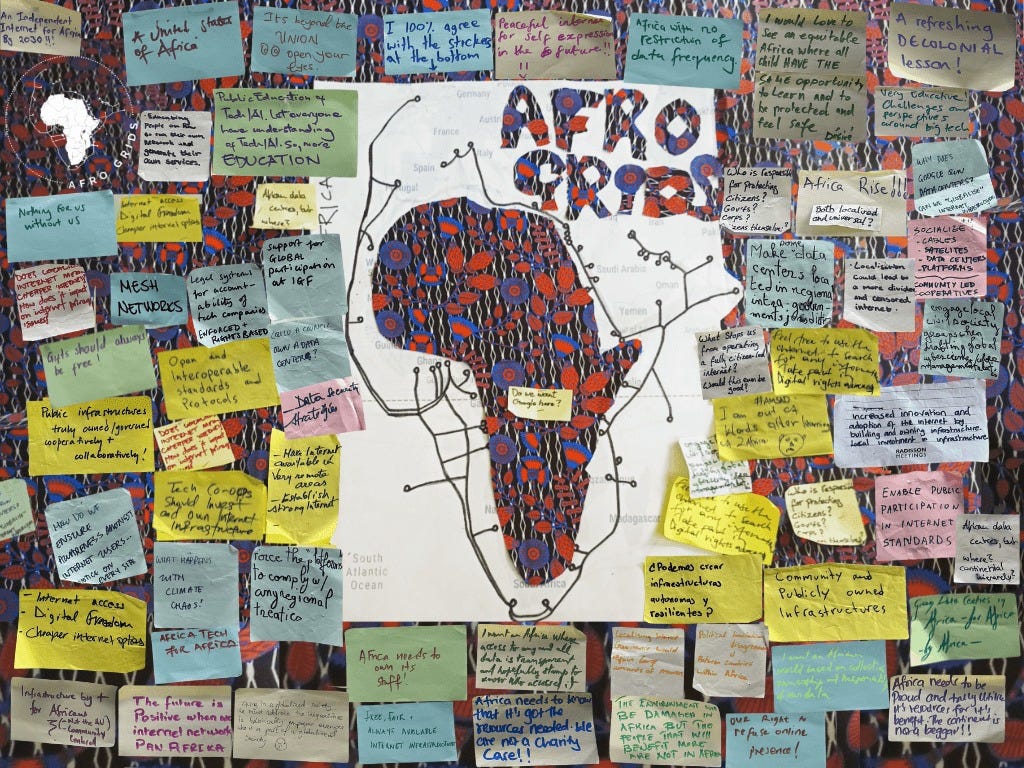
The problem: Big Tech is establishing a “quiet empire” in Africa. Its investment in essential digital infrastructure, such as undersea cables and data centres, is enforcing a system of digital colonialism, where African resources—both physical minerals and digital data—are extracted to fuel global tech monopolies. Because these companies operate on a continental scale while national policies remain fragmented, African countries lose autonomy and choice. Their dependence on extractive systems is being continually reinforced and genuine local innovation is hindered, according to Zambian digital inequalities practitioner Esther Mwema.
The solution: Mwema explained to RESET that the solution requires a fundamental shift in the digital “cosmology,” centring humanity, autonomy, and ethical tech over extractive growth, often guided by philosophies like Ubuntu.
AI is exploiting data labour in the Global South—but resistance is happening

To most of us, the rapid advancement of artificial intelligence (AI), particularly generative AI, appears to function magically. However, this actually comes at immense cost. Aside from the planet’s resources, generative AI is powered by human labour. It is, in fact, not magic, but workers predominantly from the Global South who power this technology. But that hasn’t stopped workers from fighting for justice.
How AI’s failure on linguistic diversity is deepening global inequality

The dominance of major global languages in AI models is exacerbating inequality, and nobody seems to be aware. While the Global North benefits from technology optimised for its languages, communities in the South remain excluded. They risk distorted narratives and dependency on foreign infrastructure, while dealing disproportionately with the environmental fallout. However, researchers in Africa are pushing back with innovative projects such as InkubaLM, a generative model trained on five African languages.
Map Kibera is putting Nairobi’s largest slum on the map

From unlabelled alleyways to important water points, the Map Kibera project is empowering the residents of Nairobi’s largest slum, Kibera, to create their own digital map. They are literally putting their community on the map of the city—and the world—using open-source tools and community engagement to build a vital, living database of essential local infrastructure.
Solar-powered computer labs are transforming Kenya’s remote schools

At Mjini Primary School in Murang’a County, a new solar-powered lab has given pupils access to digital learning. In many such schools, this is the first time children have touched a computer. These solar-powered digital classrooms are providing education while rewriting Kenya’s map of internet access.
Get active! Demos, campaigns, petitions…
✊ Stop the AI Greenwashing Machine! Big Tech and governments claim AI is the silver bullet for the climate crisis, but the reality is much darker. A new report commissioned by the GreenScreen Coalition exposes how power-hungry generative AI is actively harming our planet with little proof of environmental benefit. Don’t let the “tech-for-good” narrative go unchallenged; share the news with your network here.
✊ Tech Workers: Demand an End to the Violence! As ICE agents bring kidnapping and terror to US cities under the Trump administration, we know the tech industry has the leverage to stop it. We are calling on CEOs to cancel all contracts with ICE and demand they leave our communities immediately. If you are a tech professional who refuses to be complicit in this cruelty, join your colleagues and sign the ICEout.tech pledge today!
✊ Break the Dependence on Unreliable Power! Europe is sleepwalking into a trap by handing its energy future to an unpredictable Trump administration through massive LNG deals. From seizing resources in Greenland to fueling global tensions, Trump has proven he is not a reliable partner. It is time to speak out against increasing Europe’s dependence on US gas and demand a shift toward truly sovereign, sustainable energy—sign the call for action now!
Sustainability & digitalisation—Our reading tips
🌍 Finally, some tools for the climate and information crisis. The RePlaybook has officially moved from digital screens to the physical world with the launch of a new print edition. This first-of-its-kind field guide, edited by Tactical Tech’s Stephanie Hankey, brings together 30 experts to help you navigate climate-related “information disorder” and reclaim the narrative from Big Tech.
📖 Naomi Klein and Astra Taylor dive deep into the intersection of AI data centres, authoritarianism and the energy-hungry infrastructure of the future in their latest book The rise of end times fascism. This searing analysis features insights from Timnit Gebru and the Tu Nube Seca Mi Rio project, exposing the high cost of our digital addiction.
🗺️ Who owns the data of the past and future? Jasy Renyhe has launched Futuros Ancestrales, a mapping project dedicated to the sovereignty and autonomy of Indigenous peoples. It’s a vital effort to honour how these communities represent themselves—yesterday, today and tomorrow—outside of colonial tech frameworks.
🌿 Are we losing our “human touch” to an algorithm? As we outsource our friendships to chatbots and treat nature as an afterthought, this beautiful contemplation from The Guardian warns of a life void of real connection. It’s a reminder that while Silicon Valley wants to automate our existence, the way out requires a collective effort to get back in touch with reality.
🔬 Researchers have published a “recipe” for an open-source model that reviews scientific literature better than the major LLMs. Most importantly, it gets its citations right as often as human experts do—proving that AI doesn’t have to be “Big” to be brilliant or accurate.
🛸 Drones don’t lie. New thermal footage of Elon Musk’s AI power plant suggests a “different set of rules” for the tech elite, showing the facility allegedly flouting clean air regulations. The glowing heat signatures provide a rare, unfiltered look at the environmental impact of the intelligence boom.
🏗️ Concerned about the data centre land grab? Data Center Boom has launched a new repository to support Latin American communities facing the socio-environmental fallout of AI infrastructure. It’s a much-needed resource for local authorities and activists fighting for their water and land rights.
🎧 Struggling to stay optimistic in a “down cycle”? This podcast features a “Climate OG” sharing practical wisdom on how to keep your head up when the movement feels stalled. It’s a grounded conversation on resilience for anyone feeling the weight of the current environmental landscape (who could blame you).
Support solutions instead of doom and gloom: Donate to RESET
Do you like what you read and want more solutions for a sustainable world? Then support us with your donation to RESET! As a non-profit foundation, we are dependent on donations, so even a small donation can help our mission going.
Have an interesting event or project related to sustainability and digitalisation? Drop us a line at info@reset.org!